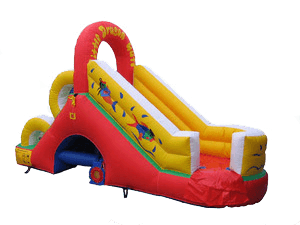
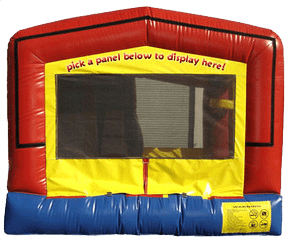
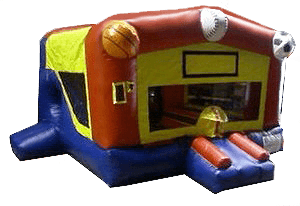
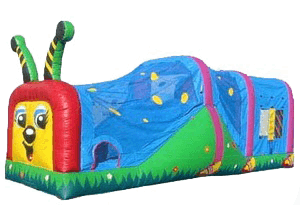
Pan a satellite view of your home so a real-scale bounce house, slide, or obstacle course sits over your yard. See what fits before you book — no tape measure required.
Rentals that fit the size you picked
Showing bounce & slide combos that are × ft or smaller. Edit the numbers to filter by a different size.
Yard size is the headline, but any of the below can stop a setup on delivery day — worth a quick check before you reserve.
Overhead clearance: 13–17 ft depending on the unit. Look for low branches, eaves, power lines, satellite dishes, and second-floor balconies.
Gate width: Most inflated units roll in deflated on a hand truck. Minimum gate opening is 36 inches. If your side gate is narrower, the unit can't reach the backyard.
Slope: Most rental companies won't set up on a noticeably tilted surface (more than ~5°). If your yard slopes, measure the flattest section, not the whole footprint.
Surface: Grass (gets anchored with stakes), concrete or turf (gets weighted with sandbags), and decks (case-by-case) all work. Mention your surface when you call.
Want to measure your yard manually?
Four quick ways to get a rough length × width — tape, fence panels, step count, or Google Maps.
Show details ↓Hide ↑
You don't need a precise survey — a rough length × width number is enough. Here are four ways to get there, ranked from most accurate to fastest.
1. Tape measure (most accurate — 2 minutes)
Run a 25 ft or 50 ft tape along the longest edge of where you'd set up. Then measure the perpendicular width at the narrowest pinch point (usually between a fence and a planter or AC unit). Both numbers are what you need.
2. Count fence panels (no tape needed)
Standard residential fence panels in California are 6 ft or 8 ft wide between posts. Walk the perimeter of your usable area and count panels. Five 8-ft panels along the back fence = 40 ft. If you can't tell whether your panels are 6 ft or 8 ft, quickly measure one and you have your scale for the rest.
3. Step it off (10 seconds)
An average adult stride is 2.5 ft. Walk heel-to-toe across the area, count your steps, and multiply by 2.5. Ten steps = ~25 ft. Less accurate than a tape, but it's usually within 10% — close enough for fit-checking.
4. Google Maps satellite (no leaving your phone)
Open Google Maps, search your address, switch to satellite view. Long-press the corner of your yard until a red pin drops, then tap Measure distance and tap the opposite corner. Repeat for the perpendicular edge. Works best for clearly-defined lawn areas — fence-to- fence is usually visible from above.
Frequently asked questions
What is the minimum yard size for a bounce house?
The smallest standard bounce houses (commercial-grade 13 × 13 ft bouncers) need at least 15 × 15 ft of clear flat space — 13 ft for the unit plus a 1 ft anchoring buffer on each side. If your yard is smaller than 15 × 15 ft, a regular bounce house won't fit; a few vendors offer smaller toddler-only units around 11 × 11 ft that can work in tight patios.
What is the standard bounce house size?
Standard residential bounce houses run 13 × 13 ft to 15 × 15 ft for the inflated unit itself, requiring 15 × 15 ft to 19 × 19 ft of setup space once you add the anchoring buffer on each side. Combo units (bounce + slide) and obstacle courses are bigger — typically 20 × 20 ft to 30 × 40 ft depending on configuration.
How much space do I need for a bounce house?
Plan for the unit's footprint plus a 1–2 ft buffer on every side for staking, blower placement, and entry/exit room. For a standard 15 × 15 ft bouncer that means a 19 × 19 ft setup area. Don't forget overhead: most bouncers need 13–17 ft of vertical clearance — measure for low branches, eaves, and power lines too.
What size bounce house do I need for 10 kids?
A standard 13 × 13 ft or 15 × 15 ft bounce house comfortably handles 6–8 kids ages 5–10 jumping at once. For 10+ kids, either book a larger 15 × 20 ft unit or a combo (bounce + slide) so kids can cycle between activities — that handles 12–15 kids easily without overcrowding.
Can a bounce house go on concrete or a patio?
Yes — most rental companies bring sandbags as an alternative anchor when staking isn't possible. Tell them when you book that the setup surface is concrete, pavers, or artificial turf so they show up prepared. The unit's footprint stays the same; only the anchoring method changes.
Does my yard need to be perfectly flat?
Slight slope is fine, but most rental companies won't set up on a surface tilted more than about 5° for safety. If your yard slopes noticeably, measure your flattest area — that's the usable setup space. Decks and step-downs interrupt the footprint and are typically rejected even if the total square footage adds up.
What if I'm not sure the bounce house will fit?
Use the calculator above to filter inflatables by your yard size, then double-check the result by either calling the rental company before booking or measuring more carefully with a tape. Vendors deal with fit questions every day and will tell you straight up whether a unit will work — they don't want a wasted delivery any more than you do.
Hosting at a park instead of your backyard?
City and regional parks have their own rules — picnic-site reservations, fees, lead times, and a few cities that ban inflatables outright. Look up your city before you book.
Browse the full catalog or jump straight to companies serving your city — most carry the insurance certificates you'll need if you're hosting at a park.